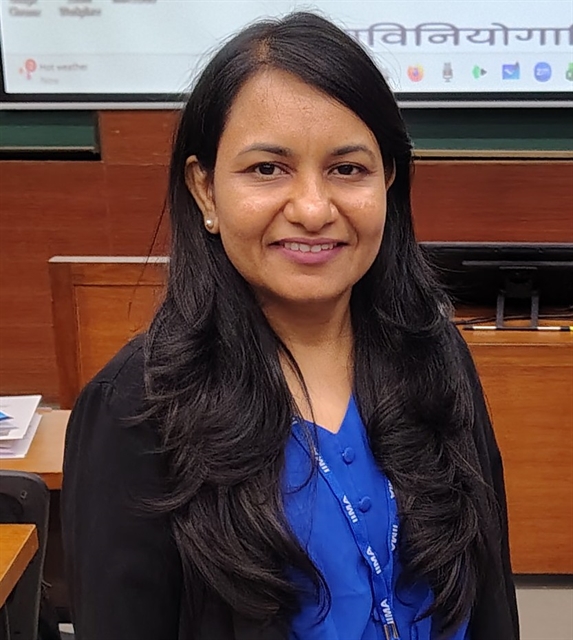
Location: Ahmedabad, Gujarat, India
Company/Organization: U.N. Mehta Institute of Cardiology and Research Centre
Title: Clinical Microbiologist – Infection Prevention and Control
First certified: October 2026
1. Why did you choose a career in infection prevention and control?
During my M.Phil. in Microbiology, my research guide invited me to attend a Continuing Medical Education (CME) programme on hand hygiene at U.N. Mehta Institute of Cardiology and Research Centre (UNMICRC), Ahmedabad, in 2015.
Attending this CME was a turning point in my professional journey. I was deeply inspired by the importance of hand hygiene in preventing healthcare-associated infections and protecting patient safety. That experience motivated me to pursue a career in Infection Prevention and Control. In 2017, I began working in this field, and since then, I have remained committed to improving infection prevention practices and patient safety.
2. What advice would you give someone who is interested in an infection prevention and control career?
My advice to anyone interested in a career in Infection Prevention and Control is to develop a strong foundation in evidence-based practices and, most importantly, remain consistent in implementing them.
An Infection Preventionist must be impartial, patient, and confident in maintaining IPC standards, regardless of professional hierarchy or individual beliefs. In daily practice, you may encounter different opinions, resistance to change, and challenging situations. However, these challenges should never compromise patient safety.
I strongly believe in being respectful in communication, firm in protecting patient safety, and consistent in practice. One principle that guides my work is: “Absence of evidence is not evidence of absence of risk.” Above all, never stop learning.
3. What does being a CIC® mean to you?
For me, achieving CIC® certification was not just about earning a professional credential. My primary motivation was to assess my knowledge and understanding of Infection Prevention and Control against internationally recognized professional standards.
As an Infection Preventionist, I frequently encounter situations where different healthcare professionals have different opinions about infection prevention practices. I wanted to strengthen my knowledge so that I could confidently discuss, explain, and justify IPC recommendations with scientific evidence.
Earning CIC® certification has strengthened my professional confidence and added credibility to my recommendations. Another rewarding aspect is that my colleagues have also expressed interest in pursuing CIC® certification.
4. What was the best studying method for you when preparing for the initial certification examination?
The most effective study method for me was practicing scenario-based multiple-choice questions and reviewing the relevant guidelines to understand the reasoning behind each answer.
I identified my weaker areas and focused on improving my understanding of those topics. I regularly referred to guidelines and resources from CDC, WHO, NHSN, APIC, and other recognized professional organizations. Rather than memorizing answers, I tried to understand why one answer was correct and the others were incorrect. Consistent practice, reviewing mistakes, and connecting theory with real-life IPC situations were especially valuable. My goal was not only to pass the examination but also to strengthen knowledge I could apply in daily practice.
5. What advice would you give someone pursuing certification?
My advice to anyone pursuing CIC® certification is to be consistent in their preparation and focus on understanding concepts rather than simply memorizing answers.
Practice scenario-based questions regularly, identify your weaker areas, and refer to evidence-based guidelines to strengthen your understanding. Do not get discouraged by difficult practice questions or incorrect answers. Instead, use them as opportunities to learn and improve. Most importantly, prepare not only to pass the examination but also to become a more knowledgeable and confident Infection Preventionist.
6. How do you stay up-to-date on infection prevention and control practices?
I stay updated on Infection Prevention and Control practices by regularly reviewing guidelines and recommendations from WHO, CDC, NHSN, APIC, SHEA, and other recognized professional organizations.
I also follow scientific publications, attend conferences, webinars, and continuing medical education programmes, and participate in professional networks such as ESCMID and SHEA. LinkedIn is another valuable platform for connecting with Infection Preventionists and healthcare professionals worldwide, exchanging knowledge, following emerging IPC topics, and sharing professional insights. I believe continuous learning and networking help keep IPC practices aligned with current evidence.
7. How has the CIC® helped you grow professionally and in your career?
Achieving CIC® certification has been an important milestone in my professional development. It has strengthened my confidence in my IPC knowledge and added credibility to my professional recommendations and evidence-based decisions.
One of the most rewarding aspects of earning CIC® certification is that my achievement has encouraged my colleagues to consider pursuing certification themselves. Professional growth becomes even more meaningful when it inspires others to learn and develop.
Although I have only recently earned CIC® certification, I see it as an important step toward expanding my professional opportunities, connecting with the international infection prevention community, and contributing to patient safety beyond my current organization. For me, CIC® is not just a credential but also a responsibility to continue learning and promoting evidence-based IPC practices.